The last twelve months have done something for Indian textiles that two decades of trade-show pitches could not.
Indian weaves, embroideries and motifs are now opening shows, closing red carpets, and shaping collections at the very top of the global fashion pyramid. That shift matters to every woven mill in the country, including ours. It changes what international brands ask for, how they pay, and which suppliers they want in the room.
At
Desai Textiles, we watch this not as spectators but as a working mill in Ichalkaranji. When the order books change, we feel it first.
A year of Indian craft on the world stage
The list of moments is long.
Cardi B closed Rahul Mishra's Paris Haute Couture Fall 2025 show
in a hand-embroidered bustier gown built with zardozi, aari and resham. In January 2026, Mishra returned to Paris with "Alchemy," and Gaurav Gupta showed "The Divine Androgyne" with more than 30,000 Preciosa crystals and Indian craft at its core.
Pharrell Williams built the entire Louis Vuitton SS26 Menswear show in June 2025 around India, with a set by Bijoy Jain, a score co-composed by A.R. Rahman, and embroideries referencing Indian iconography. In December 2025, Bhavitha Mandava became the first Indian model to open a Chanel Métiers d'Art show.
The red carpets reinforced the runway. At Cannes 2025, Aishwarya Rai Bachchan walked in a handwoven Kadwa Banarasi sari by Manish Malhotra, Janhvi Kapoor wore a Tarun Tahiliani corset and skirt in real Benarasi tissue, and Alia Bhatt closed her debut in
Gucci's first-ever sari. At Met Gala 2026, Isha Ambani's Gaurav Gupta sari carried Ajanta-fresco motifs, and American actress Camila Mendes walked in a Manish Malhotra chiffon gown inspired by Amrita Sher-Gil's palette.
This is
not a niche heritage story
anymore. It is a commercial signal.
The numbers behind the noise
The trade data is moving in the same direction.
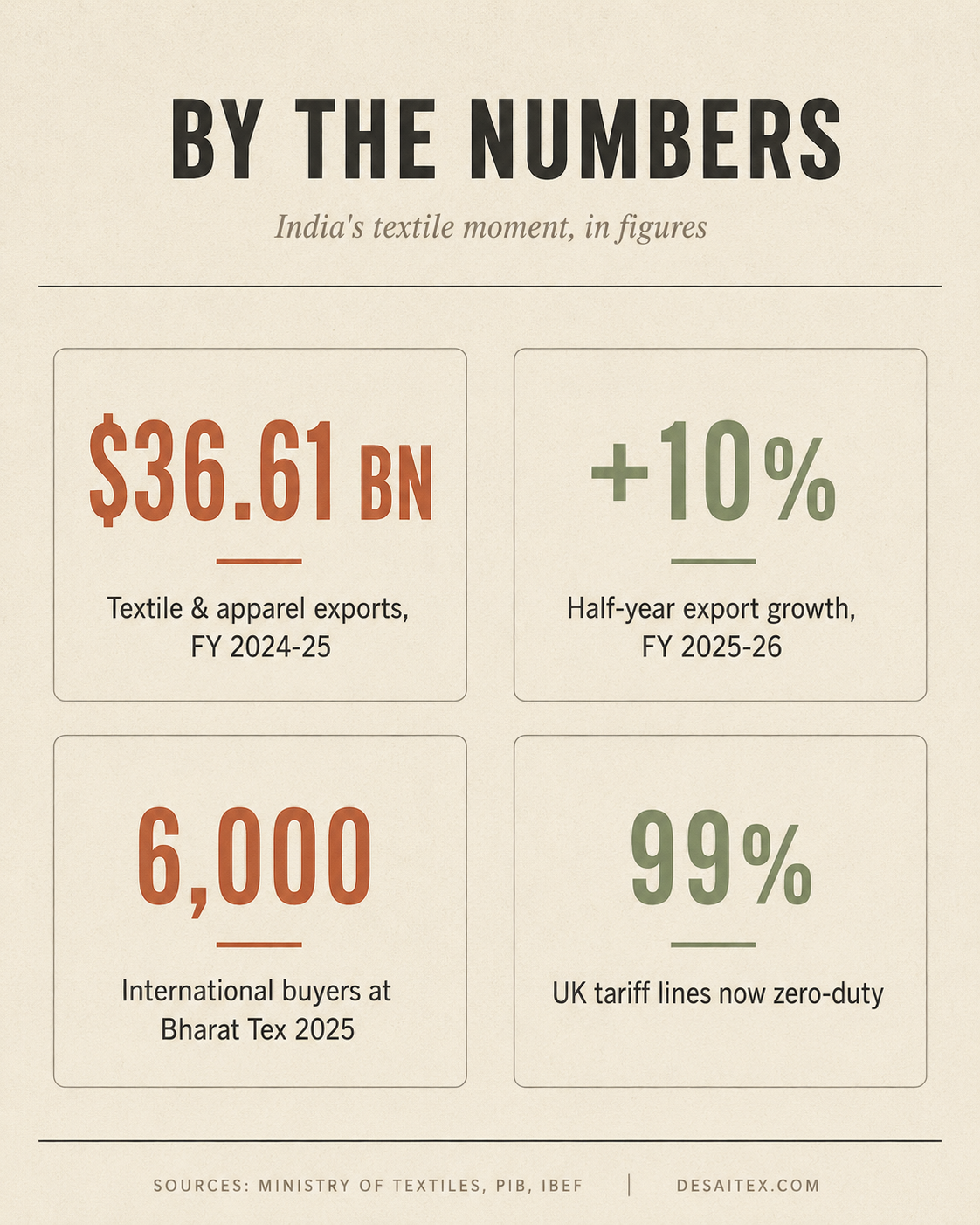
India's textile and apparel exports reached US$ 36.61 billion in FY 2024-25, up 6.32% year on year, with apparel growing over 10% (Ministry of Commerce data). Textile exports in the first half of FY 2025-26 rose 10% year on year against a near-flat global market.
Bharat Tex 2025 drew over 1,20,000 trade visitors and 6,000 international buyers from 120-plus countries, the largest textile event the country has hosted (PIB).
Policy has finally caught up. The
India-UK CETA was signed on 24 July 2025, giving Indian textiles zero-duty access on 99% of tariff lines into a market that previously charged 8-12% (PIB). In January 2026, India and the EU concluded their long-pending trade agreement, opening near-zero-duty access to a US$ 263 billion EU textile import market. By February 2026, US reciprocal tariffs on Indian goods were renegotiated down to 18%, restoring competitiveness against Bangladesh, Vietnam and China. The seven approved
PM MITRA mega parks, with a combined Rs 4,445 crore outlay, are bringing new investment into clusters that previously could not scale.